“… fascinating …”
Vanity Fair
“… entertaining …”
The Hollywood Reporter
“… classy …”
Libertas Magazine
5:30 PM Wednesday, November 4th
Live Skype interview with Director Lisa Immordino Vreeland by Joanne Lefrak
Center for Contemporary Arts

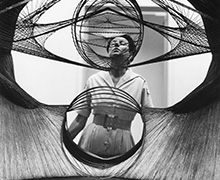
Guggenheim, one of the art world’s most colorful characters, had a bohemian flair and remarkable eye for the emerging avant-garde artist. Among those she championed were Jackson Pollock, Max Ernst (whom she briefly married), Georges Braque, and Wassily Kandinsky. Reported to have as many lovers as she did works of art, Guggenheim led a whirlwind life that took her from New York to London, Paris and Venice where she eventually settled. Venice’s Peggy Guggenheim Museum now houses her extraordinary art collection.Peggy was the child of two prominent Jewish German immigrant families, the Seligmans and the Guggenheims. The Seligmans made their fortune in banking. While the Guggenheim name today is mostly remembered for the eponymous museum founded by Peggy’s uncle Solomon, the family fortune was made in mining. Peggy’s father died aboard the Titanic when she was only 13, leaving her an inheritance that later helped fund her prodigious appetite for art.
Guggenheim’s first exposure to the bohemian world came working as a clerk in a Manhattan bookstore. But she quickly decided to spread her wings and left for Europe two years later where her collecting and exhibiting of newer artists began. Her impeccable eye, with some guidance, resulted in her amassing one of the most important collections in the modern art world. Her ability to select enduring works of art, though, did not translate to enduring marriage. She was married twice.
A live Skype interview with Director Lisa Immordino Vreeland and conducted by Joanne Lefrak follows the screening.
“… hits a grand slam.”
Wall Street Journal
“… warm and intelligent.”
Los Angeles Times
“A portrait of a hero.”
Washington Post
11:00 AM Sunday, October 4th
Q&A with Director Aviva Kempner
Optional "ball park bites" lunch
Center for Contemporary Arts
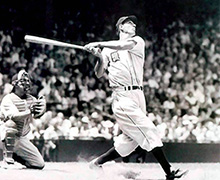
THE LIFE AND TIMES OF HANK GREENBERG is the story of a baseball player who transcended ethnic and religious prejudice to become a hero for all Americans. Hank Greenberg’s achievements during the “Golden Age of Baseball” in the thirties and forties rivaled those of Babe Ruth and Lou Gehrig.The highlights of his inspirational career constantly made the national headlines and captured the imagination not only of sportswriters but also of his loyal fans. His 1938 attempt to beat Babe Ruth’s home run record was followed closely in the press and by baseball fans all over America. In May 1941, Greenberg again made headline news as the first star ballplayer to enlist in the Armed Services. In June 1945, he was the first ballplayer to attempt a comeback after so long an absence from the sport. He did so successfully by hitting a home run in the first game he played upon his return.
As America’s first Jewish baseball star, he helped break down the barriers of discrimination in American sports and society and was a beacon of hope to millions of American Jews who faced bigotry during the Depression and World War II. His last year in baseball, 1947, coincided with Jackie Robinson’s first. Greenberg was able to offer Robinson encouragement learned from his early days, when opposing teams and fans taunted him with anti-Semitic remarks.
Director Aviva Kempner will be in attendance and an optional “ballpark bites” lunch follows the screening. For more information about the “ballpark bites” lunch, click here.
The Life and Times of Hank Greenberg has been generously sponsored by Festival Archangels Bonnie Ellinger and Paul Golding
"fascinating"
The New York Times
"(a)n engrossing subject"
Chicago Reader
"a stirring documentary"
Wall Street Journal
7:30 PM Saturday, October 3rd
Q & A with Director Aviva Kempner
Center for Contemporary Arts
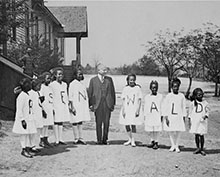
A New York Times “Critic’s Pick”, ROSENWALD is the stirring story of Julius Rosenwald, a son of German-Jewish immigrants who never finished high school but rose to become the president of Sears, Roebuck. Inspired by the Jewish ideals of tzedakah (charity) and tikkun olam (repairing the world), deeply concerned about racial inequality in America, and influenced by the writings of Booker T. Washington, Rosenwald joined forces with African-American communities in the Jim Crow South to build over 5,300 schools for African-American children. Rosenwald’s foundation also awarded grants to promising African-Americans including such future notables as poet Langston Hughes, Nobel Laureate Ralph Bunche, singer Marian Anderson, and photographer Gordon Parks. Closer to home, he established Chicago’s exceptional Museum of Science and Industry. Because of his modesty, though, Rosenwald’s philanthropy and social activism are not well known today.
Director Aviva Kempner will be in attendance. A dessert reception follows the screening.
Rosenwald has been generously underwritten by Bonnie Ellinger and Paul Golding
“’Doc’ doc rocks!”
Huffington Post
“A fascinating new documentary.”
Indiewire
“(M)oves as much as it grooves.”
The Village Voice
7:00 PM Sunday, November 9th
Center for Contemporary Arts
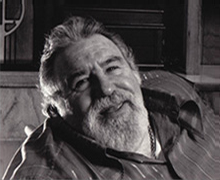
Paralyzed with polio as a child, Brooklyn-born Jerome Felder reinvented himself first as a blues singer, renaming himself Doc Pomus, then emerged as a one of the most brilliant songwriters of the early rock and roll era, writing “Save the Last Dance for Me,” “This Magic Moment,” “A Teenager in Love,” “Viva Las Vegas,” and dozens of other hits.
For most of his life Doc was confined to crutches and a wheelchair, but he lived more during his sixty-five years than others could experience in several lifetimes. “A.K.A. Doc Pomus” brings to life Doc’s joyous, romantic, heartbreaking, and extraordinarily eventful journey.
New York Triptych has been made possible by Festival Angel Marlene Meyerson. “AKA Doc Pomus” and the DJ Pizza Party have been made possible by Season Underwriter Satya Kirsch in memory of her son Jesse Leibowitz.